
For adults with OSA who couldn't stay on CPAP
CPAP wasn't the end of the road. It was the first try.
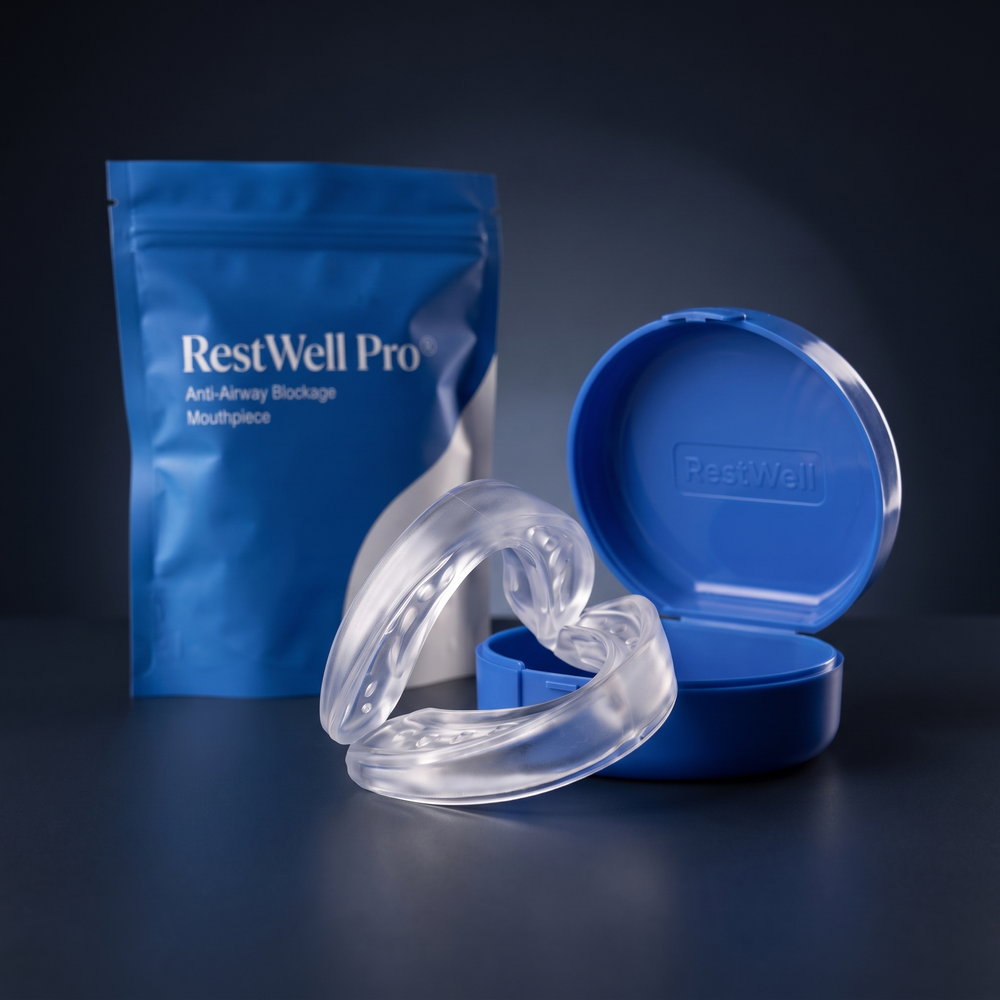
RESTWELL® Airway MouthPiece Pro
- No mask or hose between you in bed
- Stays in from lights out to alarm
- Named in sleep guidelines after CPAP
- Fits in your pocket. No outlet needed
- No hose to dry. Just rinse and go
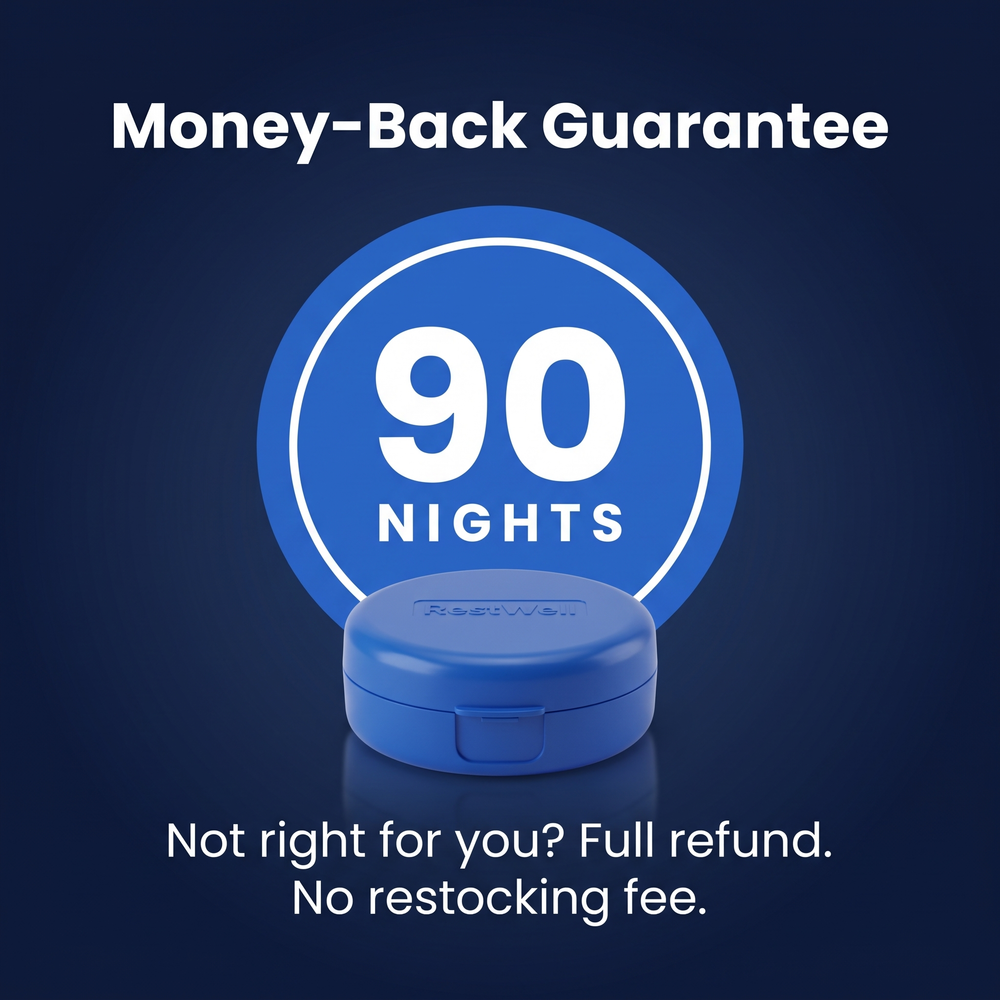
90-Night Money-Back Guarantee, No Questions
Sleep with it every night for 90 days. If it's not working for you, for any reason, contact us for a complete refund. Not store credit. Not a partial refund. The full amount, back to your original payment method.
Full refund, not store credit
No restocking fee, no partial-credit runaround
Ships in 1–2 days
Free shipping, tracking number sent same day
The Seal Problem
It was never you. It was the seal.
CPAP pushes air in from outside your body, so it has to hold an airtight seal on your face all night. That one requirement is behind:
The mask and tight straps
Leaks that wake you
Marks in the morning
A machine plugged in by your bed
6 in 10
CPAP users can't stick with it by month three.
Mask intolerance and claustrophobia are the most common documented reason. Two decades of quieter pumps and softer masks haven't changed that.
Not a willpower problem. A design problem.
Holding the Airway Open
It keeps your airway open while you sleep.
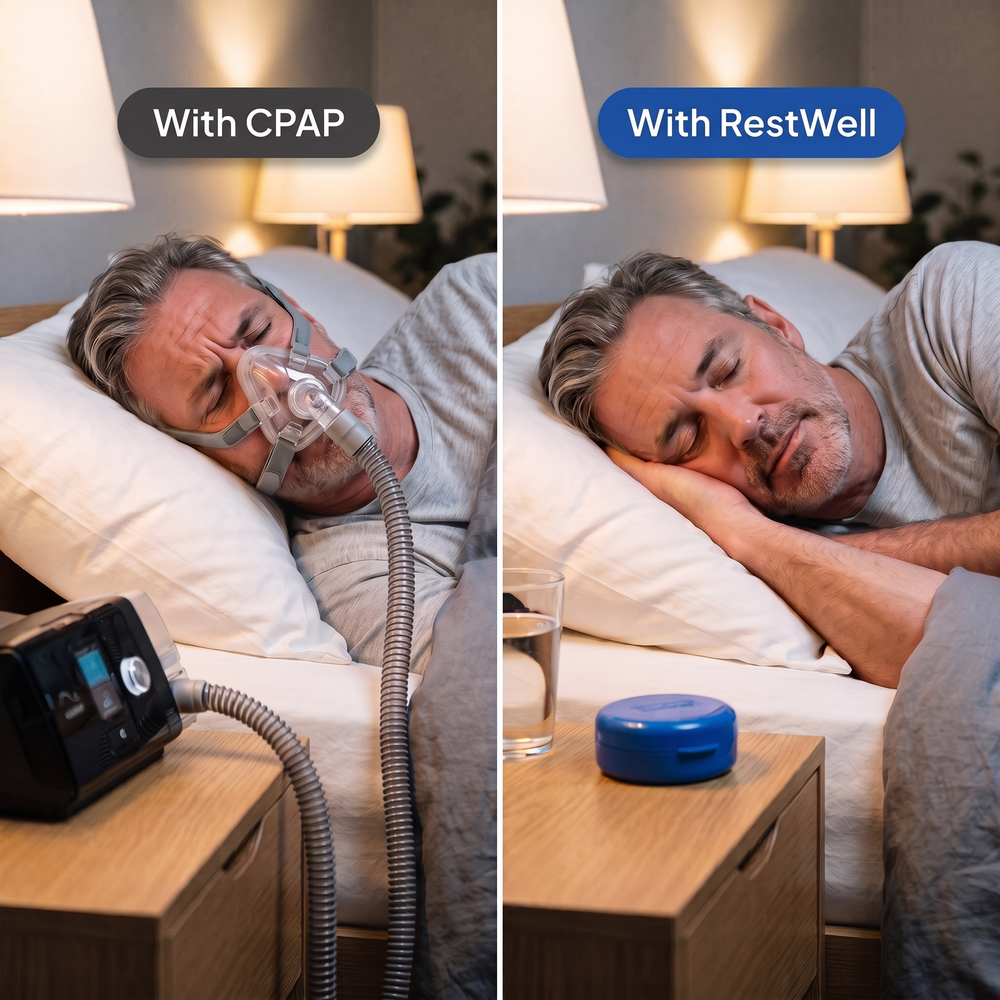
CPAP
Pushes air past the blockage
RestWell
Removes the blockage instead
How it works:
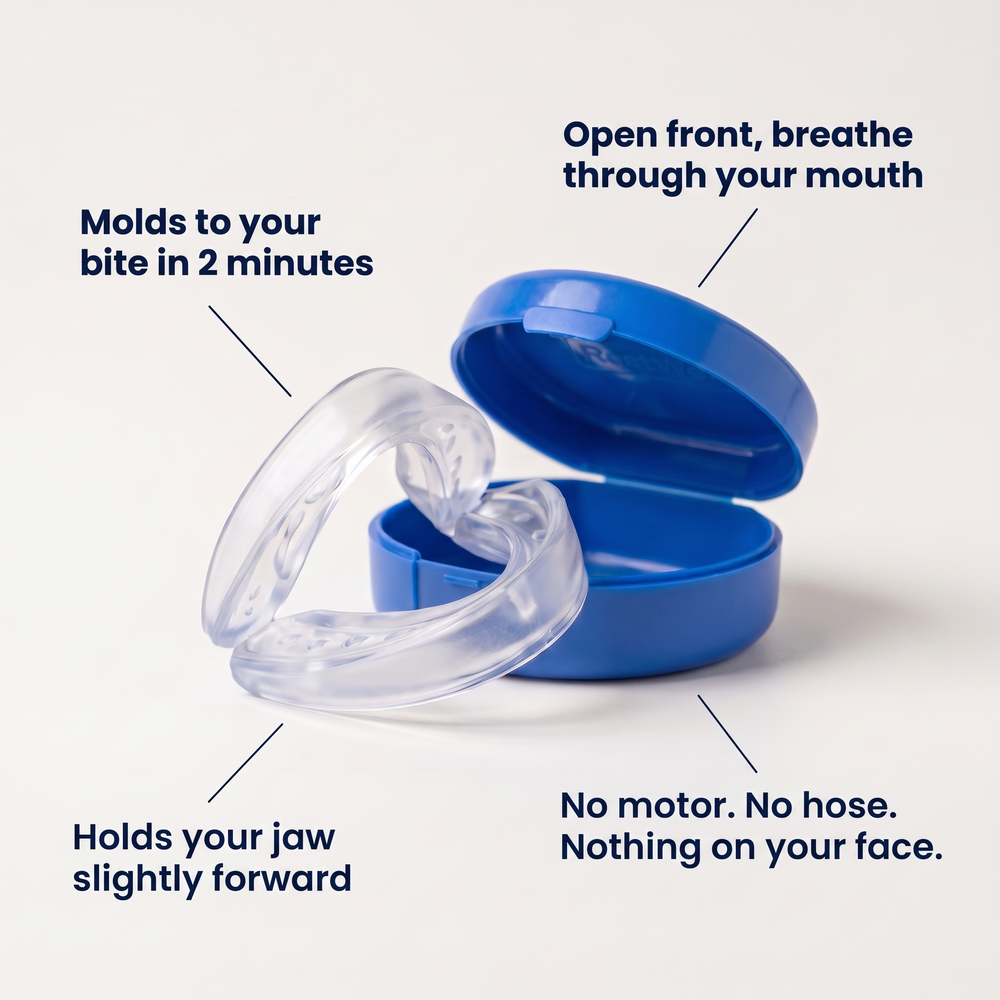
- Holds your lower jaw slightly forward
- So your tongue can't fall back
- And it can't close off your airway
No motor
No hose
Nothing on your face
Real-World Results
CPAP wins on paper. Oral appliances win in reality.
Published research finds the overall health outcome of mandibular advancement therapy is similar to CPAP's, because people actually keep using it. The guideline from the American Academy of Sleep Medicine and the American Academy of Dental Sleep Medicine found adherence with oral appliances better than with CPAP, with fewer side effects leading people to stop. If your CPAP ended up in a closet, its efficacy rating didn't matter. Efficacy you don't use is zero.
Verified buyers who came from CPAP
From people who'd already tried everything else
★★★★★
"Six years on CPAP. The mask left marks on my face every morning and my wife and I hadn't shared a bed properly in four years. First week on RestWell — no marks, no hose between us, she's back. I'm not exaggerating when I say this changed our marriage."
 Greg P. · Nashville, TN
★★★★★
"I travel for work 3 weeks out of 4. The CPAP situation was a nightmare — TSA, adapters, distilled water, praying the hotel had an outlet near the bed. RestWell fits in my toiletry bag. I haven't missed a night of treatment in 7 months."
 Michael H. · Chicago, IL
★★★★★
"My doctor told me I had 'mild-to-moderate' apnea and gave me a CPAP. The claustrophobia was immediate and I never got past night 12. I didn't even know oral appliances were an official option until I did my own research. It took me two weeks to adjust. Now it's just part of brushing my teeth."
 Carolyn B. · Portland, OR
All testimonials from verified buyers. Individual results vary.
Full comparison
RestWell vs. CPAP vs. Pharmacy mouthpiece
| RestWell | CPAP | Pharmacy MAD | |
|---|---|---|---|
| Addresses airway obstruction | ✓ | ✓ | Partially |
| No mask or facial contact | ✓ | ✕ | ✓ |
| Travel-ready (no power, no adapter) | ✓ | ✕ | ✓ |
| Nothing tracks you (no usage reports) | ✓ | Uploads your hours | ✓ |
| Clinically recognized for CPAP-intolerant OSA | ✓ | ✓ | Not typically |
| 90-night guarantee | ✓ | ✕ | ✕ |
More from verified buyers
The pattern across accounts: less equipment, same treatment
★★★★★
"My dentist had quoted me $2,800 for a custom appliance. I told him I was going to try RestWell first. Three months in, I went back and he told me I was responding. Said the mechanism was identical to what he'd have made me."
 Brenda K. · Austin, TX
★★★★★
"CPAP was a non-starter. The mask shifted every time I moved. Four months on RestWell now. Never wakes me up. Never pulls. Completely forget it's there."
 Patricia L. · Denver, CO
★★★★★
"The jaw soreness thing is real the first week, I'll be honest. By week 2, zero discomfort and it's doing its job. Worth pushing through that first week."
 Brian S. · Tampa, FL
Getting started
Setup takes about two minutes. Then you just sleep.

1
Mold it to your bite
Mold the device to your bite using the included instructions, which takes about 2 minutes in warm water. Once set, it holds that shape every night.

2
Insert before bed
Slides in over your upper and lower teeth. No mask, no straps, no machine to switch on. The whole process takes less than a minute and eventually becomes as automatic as brushing your teeth.

3
Sleep
No hose to pull, no power cord to trip on, no machine sound. The device stays where you put it.

4
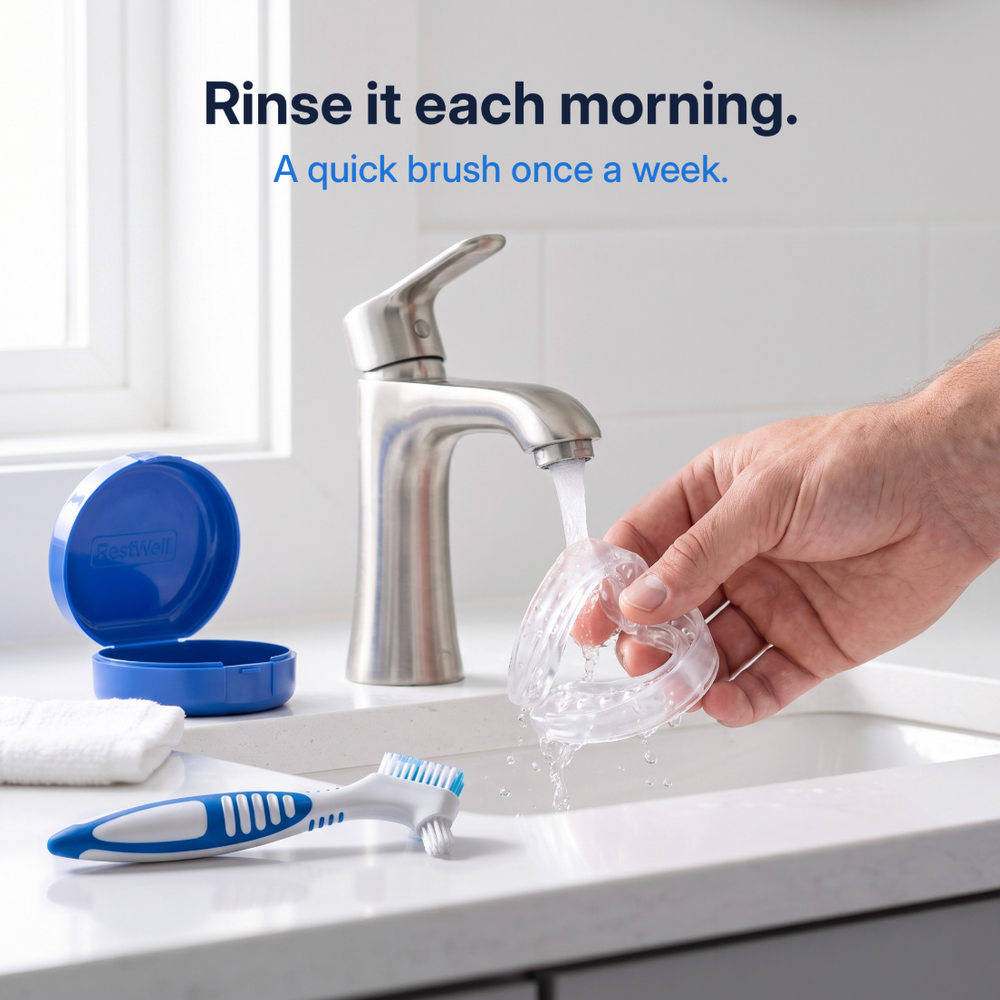
Rinse it in the morning
Rinse it each morning, keep it in its case, and give it a quick brush once a week. That's the whole routine.
What arrives at your door
Everything in one small box

No subscription, no monthly fees. One box. Everything you need for the next 6–12 months of treatment.
- RestWell Pro mouthpiece, the device itself, ready to mold
- Quick-start card, molding guide and care instructions
- First 90 Nights Guide (eBook), sent to your inbox when the order ships
- Travel case, hard protective case, pocket-sized — free with the 2-pack and 3-pack
- Mouthpiece cleaner, keeps it fresh between uses — free with the 2-pack and 3-pack
Like any oral appliance worn nightly against your teeth and jaw, RestWell is designed to last 6–12 months with regular use. This matches what dentists recommend for professionally fitted devices costing thousands more. Our multi-packs are sized around that expected lifespan.
Before you decide
FAQ
Will this cause jaw pain?
Temporary jaw soreness in the first 1–2 weeks is common and expected. Your jaw is being held in a new forward position during sleep, and those muscles need time to adapt. For most people it fades within the adaptation period. If soreness is sharp, persistent past a few weeks, or you have a history of TMJ problems, stop and speak to a dentist or your physician. That's what the 90 nights are for.
How is this different from the mouthpieces I've seen at the pharmacy?
Honestly, less than you might expect on mechanism. Both are mandibular advancement devices and both mold to your bite. We would rather say that plainly than invent a difference.
What is different is who it's built for. Pharmacy devices are packaged and sold for snoring. Nothing on the box addresses someone who was handed a CPAP and couldn't stay on it, nothing prepares you for a two-week adaptation period, and the return window is usually about fourteen days. RestWell is medical-grade TPE, it ships with a guide written specifically for the adaptation period, and you get 90 nights rather than two weeks to find out whether it works for you.
Does it just stop the snoring, or does it work on the airway?
It works on the airway, not just the sound. CPAP pushes air past the blockage in your throat. RestWell removes the blockage instead, holding your lower jaw slightly forward while you sleep so your tongue can't fall back and close off your airway in the first place.
Is this safe to use if I have moderate or severe sleep apnea?
Mandibular advancement devices are most established for mild-to-moderate OSA. The American Academy of Sleep Medicine and the American Academy of Dental Sleep Medicine recommend oral appliances for adults who can't tolerate CPAP, without limiting that to a severity level.
Here's the honest part: for moderate-to-severe OSA, CPAP is more likely to bring your numbers to target, and roughly 1 in 3 people see little improvement with a mouthpiece. If your apnea is severe, tell your doctor before switching. RestWell doesn't replace your diagnosis or your physician.
What if it doesn't work for me?
You have 90 nights to find out. That's three months of real nightly use, enough time to get through the initial adaptation period and know whether this is working. If it's not right for you at the end of 90 nights, contact us for a full refund. No partial credit, no restocking fee.
Do I need a prescription?
No prescription is required to purchase RestWell. Oral appliances are available over the counter. If you have a diagnosed sleep condition and are changing your treatment approach, we recommend keeping your physician informed, not because you need their permission, but because they should know what's working and what isn't.
When will my order arrive?
Orders ship within 1–2 business days from our US warehouse. You'll receive a tracking number by email as soon as it's on its way. Standard delivery is 3–5 business days after shipment.
From $49.99 · 90-night guarantee
Add to Cart